


Justice Luiz Fux ends the judicial semester with more than 7,000 judged cases in panel sessions
"The STF will remain vigilant in its most precious mission, which is to guard the Federal Constitution, paying attention to the constitutional feelings of the Brazilian population, and maintaining its vigilance in favor of healthy and honest elections in our country," he said.
01/07/2022
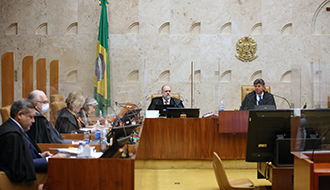
The chief justice of the Federal Supreme Court, Justice Luiz Fux, closed the semester's STF activities affirming in plenary that the Court continues to be vigilant in its precious mission "of guarding the Federal Constitution, caring for its legal security and with attention to what the Brazilian population wishes." The extraordinary session of the panel was held this Friday morning (1st) to close the activities and present Luiz Fux's term balance for the first half of 2022.
Fux highlighted that the Supreme Court will continue its path of hope towards the future and remain united around a democratic defense and the dignity of the institution, "keeping its supreme vigilance in favor of the correctness of the elections in our country." The Justice presented numbers according to which the STF has judged more than seven thousand cases in panel sessions in the first semester, and added that "the controversies faced in the period were not few, nor trivial."
Panel judgments
Fux recalled that from February to June the STF judged actions on multi-faceted electoral themes, "ensuring legal security for this year's election;" deliberated on the need of having compatibility to guarantee public security with respect for human and fundamental rights; and appreciated regulatory, tax, financial, and labor discussions "for the sake of fiscal balance, the stability business relations, and the correction of market failures," said the chief justice.
Justice Luiz Fux pointed out that the STF is the Supreme Court that decides the highest number of cases in the world and said that its statistics show the Court's "unequaled capacity" to decide cases. In the first semester, the STF deliberated on 7,019 cases judged by the panel both physically and through virtual sessions or videoconferencing. The First Panel judged 32 cases personally or by videoconference and another 2,577 in virtual sessions. The Second Panel judged 28 cases in person and by videoconference, and another 1,873 cases in virtual sessions.
Procedural filter
The Justice recalled the 15 years of the general repercussion's creation, completed in May, and referred to the relevant themes recently judged by the Court. According to him, the institute allows any citizen's case to rise from other instances to the highest Court in the country. On the other hand, it works as an "important procedural filter to establish the STF as a Court of precedents that analyzes truly constitutional affairs," he said.
Important themes were remembered by the chief justice, such as the constitutionality of the penalties imposed by the Lei Seca (Dry Law) (RE 1224374 - Theme 1,079), the guarantee of maternity leave to single parents of children generated by in vitro fertilization (RE 1348854 - Theme 1,182) and the constitutionality of collective agreements and conventions that have agreed to limit or waive disposable labor rights (ARE 1121633 - Theme 1,046).
Collection
The STF currently has the smallest collection of appeals since 1996, with a total of a little over 11,000 appeals. The rationalization of the analysis of repetitive appeals, according to the chief justice, has provided "greater speed and uniformity for the judgment of these claims throughout the country.” In the chief justice’s evaluation, the data demonstrates the partnership established between the STF and the other courts throughout the country. Those courts were responsible for indicating 28 of the 100 subjects of general repercussion proposed during his two-year term.
Administrative legacy
Fux also highlighted three projects that had been started in this first semester - the first is the Open Court, a management and transparency program aimed at structuring, disclosing, and protecting data. "One of the biggest steps towards the Court's dialogue with citizens, the press, and the academy," said the chief justice.
He also mentioned the Program to Counter Misinformation and the partnerships signed between the STF and several public and private institutions of civil society to tackle fake news. Finally, he recalled the RAFA project (Artificial Networks Focused on the 2030 Agenda), an Artificial Intelligence tool that classifies actions according to the Sustainable Development Goals (SDGs) of the United Nations 2030 Agenda, which will be available starting this month.
AR/EH - FB/LV/LM
Read more
Contact us
Praça dos Três Poderes - Brasília - DF - Brazil - Zip Code 70175-900 Phone: 55.61.3217.3000